



What Is MSM? What Does It Do? How Is It Used?


What Is MSM, in Brief?
MSM (methylsulfonylmethane), an organic sulfur compound used in food supplements, is encountered most often in searches related to joint comfort, ease of movement, and connective tissue support; however, it is not a medicine and should not be used alone for treatment purposes.
- What is it researched for? It is evaluated under the headings of joints, cartilage, post-exercise routines, and skin-hair-nail support.
- How is it used? It varies depending on the product form and the usage recommendation on the label; in sensitive stomachs, taking it with a meal may be more comfortable.
- Who should be careful? Those who use medication regularly, pregnant and breastfeeding individuals, and those with a chronic illness should consult a healthcare professional before use.
Source: NCCIH MSM evaluation
Product options: If you would like to examine the MSM product form, you can compare Qualiss MSM 100 g with Qualiss MSM 200 g in terms of label, serving size, and packaging information. The product label should be the basis for the amount to use.
MSM (Methylsulfonylmethane) is an organic sulfur compound found naturally in plants and the human body. In food supplement form, MSM is mostly researched within the context of joint comfort, ease of movement, and connective tissue routines. It also attracts interest because of sulfur bonds associated with structural proteins such as collagen and keratin found in the structure of skin, hair, and nails.
- Researched for: Joint comfort, ease of movement, and a skin-hair-nail routine
- Use: Planned according to the serving recommendation on the product label and personal tolerance
- Evaluation period: Supplement routines are generally evaluated over several weeks rather than several days
- Safety: If there is regular medication use, pregnancy, breastfeeding, or chronic illness, expert opinion should be obtained
What Is MSM (Methylsulfonylmethane)?
Methylsulfonylmethane (MSM) is an organic sulfur compound found naturally in plants and the human body. Studies on MSM focus mostly on topics such as joint comfort, ease of movement, and post-exercise routines. Although the findings are interesting, MSM is not a medicine; usage expectations, product form, and personal health status should be evaluated together.
1. What Is MSM and How Is It Obtained?
MSM is a sulfur-based organic compound known as Methyl Sulfonyl Methane. In supplement products, it is generally encountered as a white crystalline powder or in capsule form. MSM powder, which comes in a crystalline white form, dissolves easily in water.
MSM, which is found in trace amounts in nature in fruits, vegetables, grains, animal products, and milk, is largely lost during industrial food processing. For this reason, obtaining sufficient MSM with a modern diet becomes difficult, and its use in food supplement form has become widespread.
2. How Does MSM Work in the Body?
MSM acts in the body through more than one mechanism:
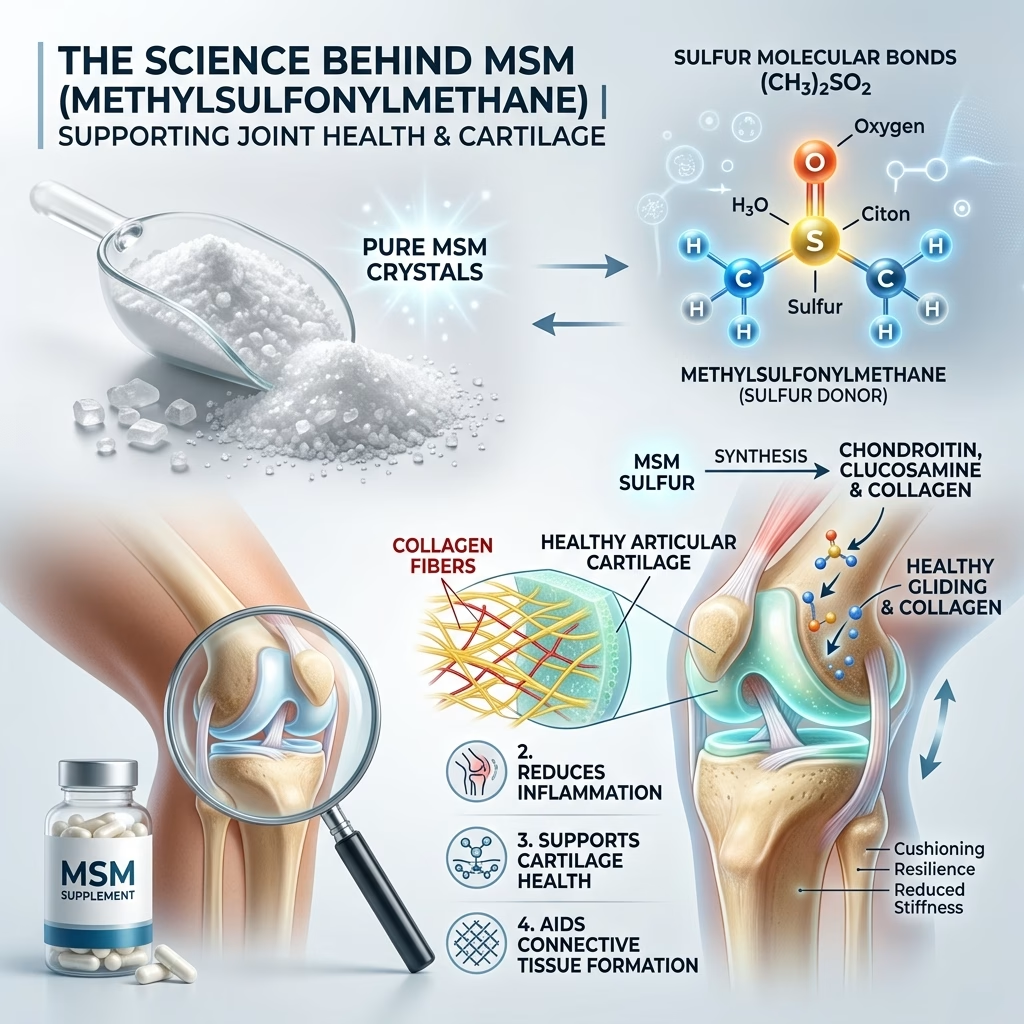
- Sulfur bonds: It supports the sulfur bonds that form the structure of joint connective tissues. Sulfur plays a critical role in the synthesis of structural proteins such as collagen and keratin.
- Support mechanisms: MSM is researched through mechanisms associated with connective tissue and post-exercise routines.
- Oxidative stress studies: Some publications evaluate MSM under the headings of post-exercise oxidative stress and recovery [1].
- Ease of movement: Joint comfort and ease of daily movement are the topics most frequently seen in MSM searches.
3. MSM Benefits and Areas of Use
The potential benefits of MSM supplementation that are most researched in the scientific literature are as follows:
- Joint and cartilage routine: MSM is mostly researched for joint comfort and ease of movement; there are also products in which it is evaluated together with ingredients such as glucosamine and chondroitin. Read our detailed guide on joint health.
- Skin, hair, and nails: Because of sulfur’s role in keratin and collagen production, it may support skin elasticity and hair/nail strength.
- Post-exercise recovery: It may support the repair process of micro-damage that occurs in muscles and joints after intense exercise. We have also covered the active-lifestyle side in our recommendations that support freedom of movement article.
- Seasonal discomforts: Some studies show that MSM use may help reduce the severity of seasonal allergic symptoms.
4. How Is MSM Used? (Dosage and Timing)
MSM is a supplement ingredient reported to be well tolerated by most users; even so, the daily amount should be evaluated according to the product label, the purpose of use, and personal tolerance.
- Best time: In the morning or with lunch. Taking it late in the evening may make some people feel energetic and affect their sleep.
- On a full stomach? People with a sensitive stomach should use it on a full stomach and with plenty of water.
- Evaluation period: Supplement routines are generally evaluated over several weeks rather than several days
5. MSM Side Effects and Safety
MSM is a supplement ingredient reported to be well tolerated by most users; even so, some people may experience stomach sensitivity, headache, or similar unwanted effects. People who use medication regularly, pregnant and breastfeeding individuals, and those with a chronic illness should consult a healthcare professional before use.
- Mild nausea or bloating (generally at high doses)
- Rarely, mild headache (generally in the first days)
- Very rarely, skin rash
Pregnant or breastfeeding women, people who use medication because of a chronic illness, and individuals who are about to have a surgical operation should consult a health professional before using MSM.
6. Who Should Use MSM?
- Active athletes: Those who want to support muscle and joint recovery after intense training.
- Middle-aged and older individuals: Those who want to support the sulfur stores that decline with aging.
- Desk workers: People whose joint comfort is affected by prolonged inactivity.
- Those who want to support skin and hair health: Those who want to strengthen the keratin and collagen structure.
7. Reviews from MSM Users
Positive feedback:
- Many users report a noticeable improvement in joint comfort.
- There are users who report smoother skin and stronger hair/nails.
- Feedback that muscle soreness decreases and recovery times are shortened is common among athletes.
Points to note:
- It is emphasized that regular use for at least a few weeks is required to see the effects.
- The optimal dose may vary from person to person; starting with a low dose and increasing gradually is recommended.
8. Frequently Asked Questions
Does MSM cause weight gain?
No. MSM is a mineral compound that contains no calories. It has no appetite-stimulating or fat-storing effect.
Can MSM and collagen be taken together?
Yes. Because MSM supports the sulfur bonds used in collagen synthesis, it works synergistically with collagen supplements. Read our detailed guide on the synergy of MSM and collagen.
Does MSM upset the stomach?
It is generally very well tolerated. People with a sensitive stomach are advised to use it on a full stomach and with plenty of water.
How long does MSM take to work?
Because articular cartilage is an avascular tissue, it takes time for nutrients to reach the cartilage. In scientific studies, 8-12 weeks of regular use is recommended.
Should MSM powder or capsules be preferred?
Both forms are effective. The powder form is absorbed faster and dose adjustment is more flexible. Capsules are preferred for convenience and portability.
Pure MSM Support
If you are looking for practical MSM support in your daily routine, you can consider high-purity MSM support options.
Frequently Asked Questions About MSM
Is MSM a Medicine?
No. MSM is considered in the food supplement category; it should not be used in place of medication for the purpose of treating a disease.
What Should You Look for When Choosing MSM?
Ingredient purity, usage instructions, manufacturer transparency, and possible interactions with current medications should be evaluated together.
Product link: Check out Qualiss MSM.
Scientific Sources and the Limits of the Evidence
Human studies on MSM have mostly been conducted with small groups of participants over limited periods. Although some studies report changes in joint function, pain, or post-exercise markers, the results do not show that MSM treats a disease. Supplement use should be considered together with the product label, personal health status, and the evaluation of a healthcare professional.
- NCCIH: Evaluation of the use of DMSO and MSM in osteoarthritis
- Kim et al. (2006): 12-week randomized, double-blind, placebo-controlled pilot study in knee osteoarthritis
- Debbi et al. (2011): Randomized controlled trial in knee osteoarthritis
- Usha and Naidu (2004): Randomized controlled trial comparing glucosamine, MSM, and their combination
- Withee et al. (2017): Randomized controlled trial on pain and oxidative stress after a half marathon
- Nakhostin-Roohi et al. (2013): Randomized controlled trial on oxidative stress markers after acute exercise
İyi günler, günde 1 mg. İle 6 mg. Arası kullanılır diyorsunuz bunu nası ölçeceğim kuyumcu terazisi lazım. Lütfen ev ortamında kaşıkla ölçü verirseniz ona göre alıp kullanacağım.(bu arada 73 yaşındayım). Teşekkürler.
Hello
The scoop included holds about 3-3.5 grams of MSM, so you can measure accordingly.
We wish you good health.